How Was Artificial Intelligence Born?
INTELIGENCIA ARTIFICIAL
Fabricio De los Santos
5/20/20264 min read
When someone asks me who the father of Artificial Intelligence is, the first name that comes to my mind is Alan Turing.
But the answer is not so simple.
Turing gave us one of the deepest questions behind AI:
Can machines think?
John McCarthy, on the other hand, gave the field its name. He coined the term Artificial Intelligence and helped organize the famous Dartmouth conference in 1956, considered by many as the formal birth of AI as a discipline.
So maybe this is not a story about only one father.
Maybe this is a story about how an idea was born little by little, through different minds, different problems and different moments in history.
Alan Turing and the Question That Changed Everything
During the Second World War, Alan Turing worked at Bletchley Park, the British codebreaking center.
The goal was clear: to help decode the messages encrypted by the German Enigma machine, a system used by the German army to communicate military operations.
Turing helped design a machine called the Bombe, inspired by previous Polish cryptographic work. To simplify the idea, the Bombe was not “thinking” like a human being. But it was doing something extraordinary for that time.
It was testing possibilities.
It was reducing complexity.
It was taking a problem that could take humans an enormous amount of time and transforming it into something that could be attacked mechanically.
And maybe that is where one of the seeds of Artificial Intelligence was planted.
Because when you see a machine helping humans solve a problem that seems impossible, a new question appears:
Where is the limit?
If a machine can calculate…
If a machine can follow logic…
If a machine can find patterns…
Could a machine also imitate intelligent behavior?
The Turing Test
In 1950, Turing published his famous paper Computing Machinery and Intelligence.
Instead of trying to answer directly the question “Can machines think?”, he proposed a different approach.
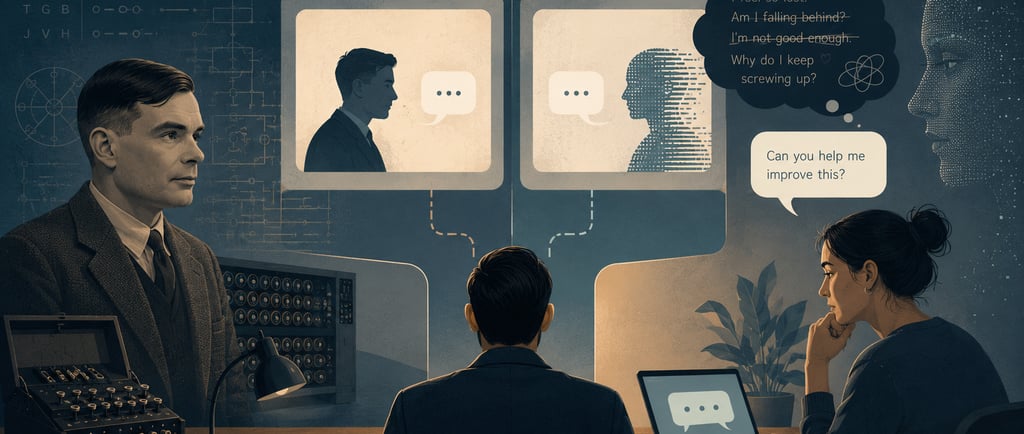
Imagine that a human evaluator is having a written conversation with two hidden participants.
One is a human.
The other is a machine.
The evaluator can ask questions, read the answers and try to decide which one is the human and which one is the machine.
If the evaluator cannot reliably tell the difference, then the machine could be considered intelligent, at least in terms of behavior.
That is the essence of the Turing Test.
It is not about proving that the machine has consciousness.
It is not about proving that the machine has emotions.
It is about something more practical:
Can a machine imitate human conversation so well that we cannot easily distinguish it from a person?
And today, when we use tools like ChatGPT, that question feels more alive than ever.
How many times have we had a conversation with an AI and, for a few seconds, forgotten that we were talking to a machine?
That does not mean the machine is human.
But it does mean that Turing was asking the right question many decades before the world was ready to understand it.
John McCarthy and the Name of Artificial Intelligence
A few years later, John McCarthy helped give this field its identity.
If Turing asked the philosophical question, McCarthy gave the field its name.
He coined the term Artificial Intelligence and helped organize the Dartmouth conference in 1956, where researchers began to treat AI as a formal discipline.
That is why McCarthy also deserves a central place in this story.
Because naming something is powerful.
When you name something, you make it visible.
When you name something, people can gather around it.
When you name something, you create a territory.
Turing gave us the question.
McCarthy helped create the field.
Why Turing Still Comes First to My Mind
I do not want to start a historical discussion about who deserves the title of “father of AI”.
Probably there are many people who contributed to this story.
Alan Turing.
John McCarthy.
Marvin Minsky.
Claude Shannon.
The Polish mathematicians who worked before the British Bombe.
And many others.
But there is something about Turing that connects with me personally.
When I started in the computer world, I studied in a place called Turing Institute.
At that moment, the name was already familiar to me, but later, during my university years, I studied his work in more detail.
Many years after that, when I watched The Imitation Game, the movie brought that curiosity back.
Of course, the film has fictional parts, because cinema needs drama. But it made me return to the real story, to the machine, to Enigma, to the logic behind the code, and to the mind of someone who was not only solving a military problem.
He was opening a door.
A door that today we are all crossing.
From Turing to Today’s AI
Turing was not building ChatGPT.
McCarthy was not thinking about prompts, tokens, agents or generative AI.
But they were asking questions that are still with us.
Can a machine imitate intelligence?
Can a machine solve problems that seemed reserved for humans?
Can a machine help us think better?
Today, Artificial Intelligence is no longer hidden inside laboratories.
It is in our browsers, our phones, our companies, our emails, our code editors and, little by little, in the way we work.
But maybe the most important lesson from Turing is not that machines can think.
Maybe the real question is different.
If machines are starting to think with us...
Are we still learning how to think better?
Watch the Spanish video version
I also recorded a Spanish video version of this reflection, where I explain the idea in a more conversational way. You can watch it here:
And I’ll see you on my YouTube channel:
@podcastfabricio
See you soon!
Fabricio De los Santos
AI Solutions & Integration Architect | Business Automation | Systems Integration | Applied AI